
Table of Contents
When operating your business in Pennsylvania, you may refer to it by a name other than what was registered with the Department of State. This is known as a fictitious name. You can think of it as a nickname for your business. While the ability to call your business by a fictitious name affords you flexibility, there is a registration process governing how and when the name may be used.
Pennsylvania’s Fictitious Names Act (FNA) requires any business operating in the Commonwealth of Pennsylvania to register all fictitious names with the Department of State. According to the Act, a fictitious name is “any assumed or fictitious name, style or designation other than the proper name of the entity using such name.” In this context, a proper name is considered what the original name of your entity was when filed with the Department of State. For example, let’s say someone named Al launches a business and names it ABC Corp. Later, the business became known in the community as Al’s Rugs. Al now has a duty to register “Al’s Rugs” as the fictitious name of ABC Corp.
Why All the Fuss? The Importance of FNA
“America is the land of free enterprise,” you say. “Why is the government forcing me to register my nickname?” While we applaud your love of free markets, you must understand that in order for free markets to operate properly, businesses must have a level of transparency with the general public.
This allows creditors to find the person who is doing business under the fictitious name, lets consumers investigate who they are buying goods and services from, and allows the company that registered the fictitious name to open bank accounts, accept payments, and offer themselves to the world under that name. It does not matter if you are a sole proprietorship, an LLC, a partnership, or a corporation; every entity in Pennsylvania must legally comply with the FNA for the public good.
Should you forego registration, failure to comply may trigger Pennsylvania’s Consumer Protection Law, which may amount to thousands of dollars in fines.
How to Register Your Fictitious Name in Pennsylvania
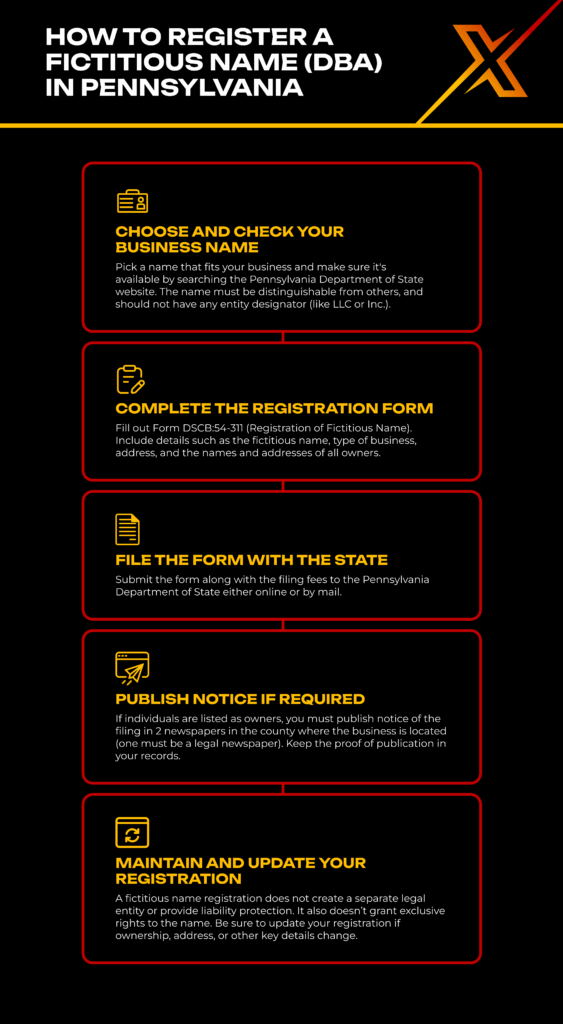
In order to register a fictitious name, you must file the Fictitious Name Registration Form DSCB:54-311 with the Pennsylvania Department of State, enclosed with the $70 fee. This may also be done online through the Department of State’s online portal. Your fictitious name application must contain the following information:
With the help of a business lawyer, you can minimize the risk of making mistakes in these critical areas. Our legal team is always available to guide you throughout this process.
Advertising Your Fictitious Name
You must publish an advertisement that confirms the fictitious name registration. This is only applicable if there is an individual listed in Box 4 of the form. If the registration does not list an individual, then advertising is not required. You must place the ad in two newspapers within the county where the business is located. See 15 Pa.C.S. §102 for more information on publication guidelines.
The advertisement must contain the following information:
- The fictitious name
- The address of the principal office or the place of business of that business that is using the fictitious name
- The name and address of the person filing the registration
- A statement that an application for registration of a fictitious name is to be or was filed under 54 Pa.C.S. (relating to names).
You can obtain a list of the legal newspapers that you can use to advertise this registration. You will need to maintain proof of submitting the advertisement, though you do not need to submit that information to the Department of State.
Do You Receive Exclusive Rights to Your Fictitious Name After Registration?
One of the most important concepts to understand related to this law is that registering your fictitious name does not provide you with any exclusive rights to use that name. The law does not provide any ownership rights to that name, and another company may use it. You will not be able to use the same fictitious name that numerous other companies use, but you maintain no legal ownership once registered.
The fictitious name registration process is not a trademark or copyright. While you can take steps to secure your trademark over these names, this registration process in itself is not enough to do so.
This is one of the reasons why you should work with a business attorney throughout this process. Your lawyer will make sure you are not using anyone else’s name and will also minimize the risk of someone abusing their ability to use your name.
It certainly becomes confusing, but having an attorney to guide you can minimize some of the risk associated with the process.
Registering Your Business Name as a Trademark
As a business owner, you know that your business name is a critical asset for your company. You are not required to register your business name as a trademark, but doing so can provide benefits. You can do this as a federal and/or a state trademark.
If someone has a name that is very similar to yours and is already using that name for their business or organization, you should avoid using it. You should not choose a name that could be confused with another name that is registered.
Work with an attorney to trademark your fictitious name. Once you get the trademark, that registers your name or slogan with the Department of State. This then provides you with a way to file a lawsuit against another party if they attempt to use your name.

How to Use Your Fictitious Name
Once you have your fictitious name registered with the same, you can start using it. That means that you can feel confident communicating that name with others. Most businesses will use their fictitious name for various needs, but it is essential that you do so within the letter of the law.
For example, if you enter into a contract with another company, you should use your full business name, and not your fictitious name. However, you should include all of the fictitious names that your company is known for on contracts and agreements to ensure that there is clarity on which company is involved. You can do this on a contract by adding a DBA, d/b/a, or “doing business as” stipulation to the contract. This clarifies that your contract is for your business, whether the company you are signing it with knows you by your formal or fictitious name.
Have More Questions? Speak To a Business Law Attorney In Pennsylvania
Overall, Pennsylvania’s fictitious name requirements are easily met. Doing so will help you stay compliant and officially hold your business out to the community by your new name. Our legal team can provide you with the guidance you need to ensure you meet all requirements under the law.
Our legal team can help you in several ways with the entire process:
- We will help you determine if the name you wish to register is available and is unique enough to meet the Commonwealth’s requirements. This ensures that you are not trying to register someone else’s name and end up with limitations later.
- Our attorney will ensure that your application is accurate and meets all legal compliance requirements. This will minimize the risk of the application being rejected. This could also reduce costs should you have to reapply for the process.
- When you meet with our legal team, you can ask us all of the questions you have. We will help clarify the limitations of your fictitious name registration. That includes ensuring you understand that it does not create a separate legal entity and does not provide any personal asset protection.
- We can help you move towards getting a trademark and taking other steps to protect your intellectual property rights.
- Expect our attorney to provide legal advice on your current business structure. If you are a sole proprietorship or a partnership, and you are using a fictitious name, you have no liability protection for your personal assets. We can help you determine if you should form an LLC or other business entity to increase your protection under the law.
When you make the decision to work with AttorneyX, you gain an advocate who has the sole goal of helping you to achieve your best outcome. That is to keep your business within the legal requirements present, but also to ensure you are not limiting your business from operating legally.